
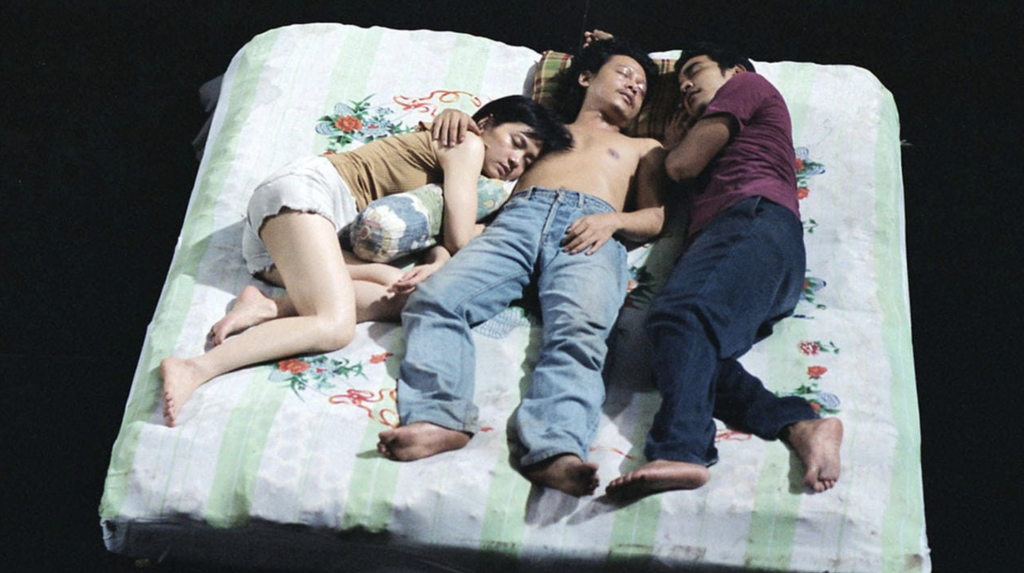
Tsai Ming-Liang is a Taiwanese film director who at the age of twenty, moved from his birthplace in Kuching to Taipei. He expresses the impact this change had on his life, as he has stated that he feels as if he belongs neither to Taiwan nor to Malaysia, but rather feels a lack of belonging to either culture. His work has been acclaimed worldwide, including his film I Don’t Want to Sleep Alone, a movie with two perspectives on the notion of care ethics. It is likewise through the evident use of symbolism and unique cinematography, that the film effectively challenges the rigid class structure and stressed social norms established by society, all while portraying two conspicuously different relationships and their effect on care.
It is likewise significant, however, to consider the socio-political context in I Don’t Want to Sleep Alone and Malaysia prior to analyzing such traits of the film. For one, the racial tensions in Malaysia can be arguably attributed to British colonialism, as it greatly affected the still evident racial divisions. Regardless of gaining independence from Britain in 1957, social unrest persisted, such as the race riots between the Malays and the Chinese in 1969 (Chan 16_). The Chinese are still the racial minority in Malaysia, yet retain economic primacy. Furthermore, as Keneth Chan states in “Queerly Connecting”, Tsai “taps into the complex racial dynamics” (163 in his film. For instance, despite the fact that there is a higher proportion of wealthy Chinese in Malaysia, the film portrays the reversal of such stereotyped roles of economic dominance, as Lee Kang-sheng’s character is the nameless “Homeless man”. In this case, the ethnically Chinese character relies on the support of the Rawang, the Malay of a lower socio-economic class, not the other way around. The film likewise delves into the topics of sexuality and desire, as the relationship between the Homeless man and Rawang can arguably depict the development of a homosexual relationship. Chan additionally mentions that heterosexual couples experience a lack of sexual expression, thus making “queer identities and queer communities … accrue a sexual underclass status, with the mainstream making queerness so abhorrent in the public sphere” (Chan 166). As a result, the portrayal of sexuality and the character’s opposition to societal norms dissipates the facade of the “racially and politically charged Malaysia” (Change 166). Therefore, by portraying the social situations as such and by rejecting what was socially common, Tsai Ming-Liang portrays the oppressed through a disability, queer, and socio-economic lense, overall emphasizing how they themselves are not disabled by their own differing ideologies, but by the rigidness of the established societal constructs within their surrounding environment.
As noted, I Don’t Want to Sleep Alone portrays care through two differing perspectives, one between the Coffee-Shop Boss and her disabled son that is more abusive, mechanical, and emotionally removed, while the other between the Homeless man and Rawang is characterized as more intimate. It is feasible that the abusive relationship is one created as a means of control over a less-abled body who is treated more as an object rather than a human being, while the more intimate focuses on nurture, and plausibly, the revelations of desire. By employing unique traits and use of symbolism, the film not only reveals a resistance to societal conformity, but also places the two relationships together as a juxtaposition to one another.
First, the film does not use customary Hollywood film tactics, as there is seldom verbal interaction between characters. Consequently, much of the film is observed with a silence that creates intimate interactions, particularly between the Homeless man and Rawang. All that is heard in several scenes of the film is background noise of busy streets and public chatter, thus challenging the viewer to solely focus on the two characters. Whether the lack of dialogue may stem from the language barrier between the Homeless man and Rawang, or the son’s speech impairment, Tsai reveals how much can be expressed with limited dialogue. Furthermore, there is audio that deceives. In a particular scene, for example, there is a song whose lyrics state: “my voice is weakened and my body frail… if not for you I would have flown into the depths of an alligator’s belly… I would have sunk into the ocean deep underwater…”. What seems as rather endearing lyrics is actually the song playing as the audience views the abusive relationship between the Coffee-Shop Boss and her disabled son. The lyrics clearly portray the notion of dependency, however, a deeper analysis of the lyrics reveals far more. By having the song contrast the abusive relationship depicted in the scene, the background music resists what is evidently shown and challenges what is seemingly portrayed as a mere facade of not only the scene itself, but of society as a whole. Thus, the scene depicted of the Coffee-Shop Boss and her son may represent the “racially and politically charged Malaysia”, while the background music symbolises the lingering desires of the oppressed.
Furthermore, much of the film’s scenes take place in an abandoned building. Initially, the building may symbolize the injustices brought upon through colonialism, capitalization, and urbanization that resulted in the exploitation and displacement of entities, as seen in the rigid social structure. Nonetheless, the building may also represent Tsai Ming-Liang’s sense of isolation of neither connecting to Taiwan nor to Malaysia as well as the Homeless man’s solitude as an immigrant. Finally, it symbolizes the abandonment of social norms. As stated in “Queerly Connecting”, heterosexual couples experience a hard time with sexual practices and expressions. However, it is in the abandoned building where the Homeless man and the Coffee-Shop Waitress attempt to engage in sexual intercourse. Moreover, the Homeless man is in the abandoned building when a moth lands on his shoulder. As the moth symbolizes change and attraction, this moment may represent the Homeless man’s realization of his potential desire for Rawang. Consequently, this paves the development of a potential homosexual relationship, which is commonly treated with disdain by society. Hence, it is through Tsai Ming-Liang’s use of symbolism that his film I Don’t Want to Sleep Alone challenges the set ideologies rigidly established by society.
Finally, as noted, by juxtaposing the two plots that portray care as mechanical, abusive, and with much resentment and the other with intimacy, the film questions the ethics of care. As Eva Feder Kittay questions in her essay on “the Ethics of Care, Dependence, and Disability”, is it “not better to acknowledge our dependency as a feature of all human life, and to develop relationships that are genuinely caring and respectful?” (Kittay 54). This perspective makes dependency appear as something that saves us “from isolation and provides the connections to another that makes life worthwhile” (Kittay 57), which is in congruence with Rawan’s nurturing treatment towards the Homeless man. Thus, this leads one to question whether the ethics of care can go beyond the mere supervision of another individual.
